Singapore dominates SEA PE dealmaking in Q1: report
The city-state accounted for 94% of regional deal value, driven by megadeals in data centres and education.
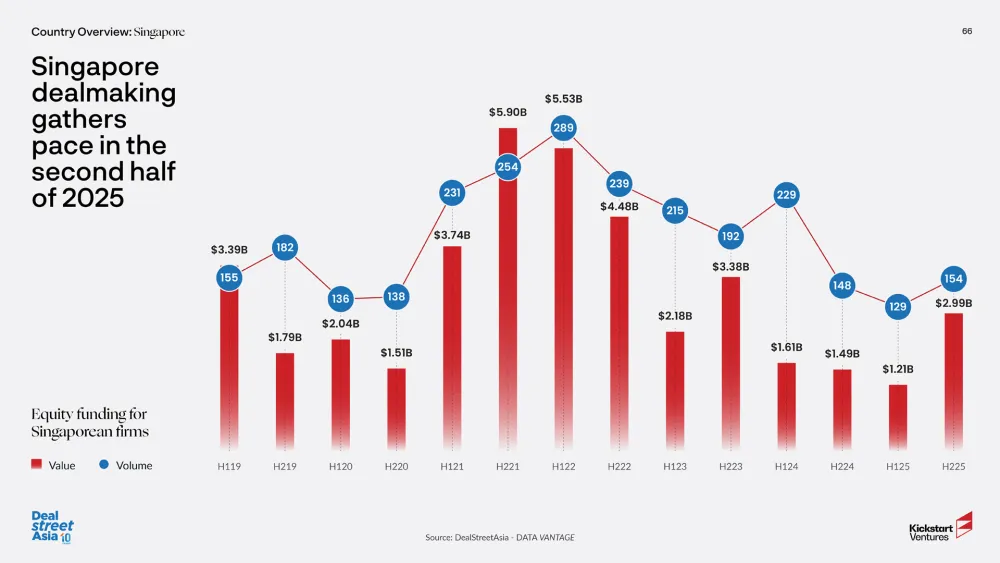
Singapore remained Southeast Asia’s main private equity hub in the first quarter of 2026, accounting for about 68% of deal volume and 94% of total deal value, according to EY-Parthenon.
The region recorded 19 PE deals worth $12.0b (US$9.2b) during the quarter, the highest quarterly deal value in the past five years. Deal value surged 4.5 times YoY, whilst deal volume rose 36%.
Singapore-headquartered companies dominated the largest transactions. KKR’s acquisition of the remaining stake in ST Telemedia Global Data Centres was valued at $6.7b (US$5.1b), making it the biggest PE investment in Southeast Asia in Q1.
Another major deal was the $2.6b (US$2.0b) investment in DayOne Data Centers by Coatue Management and the Indonesia Investment Authority. KKR’s $1.7b (US$1.3b) acquisition of XCL Education Holdings also ranked among the top transactions.
EY said investor interest in digital infrastructure continued to intensify, supported by hyperscaler expansion, AI-driven compute demand, data localisation mandates, and opportunities to scale power and connectivity assets in Southeast Asia.
Infrastructure accounted for 77.1% of regional PE deal value in Q1, followed by consumer at 14.5% and technology at 7.0%. Three megadeals above $1.3b (US$1b) made up about 91% of total capital deployed.
PE-backed exits in Southeast Asia reached $2.2b (US$1.7b) across six deals. Exit volume was unchanged YoY, but total exit value rose 75%, largely driven by TPG Capital’s divestment of its majority stake in XCL Education to KKR.
Fundraising remained muted as limited partners stayed cautious amid geopolitical uncertainty linked to the Middle East conflict. Across the Asia Pacific, only six funds closed in Q1, raising $3.1b (US$2.4b), compared with 28 funds raising $11.6b (US$8.9b) a year earlier.
EY said geopolitical and macroeconomic volatility remains the top concern for general partners, with 56% citing it as the biggest risk to portfolio performance over the next 12 to 24 months.












 Read Here
 Advertise
 Sign Up