Australia's personal accident and health to hit $28b by 2030
It recorded 5.3% expansion in 2025, reflecting pricing resilience.
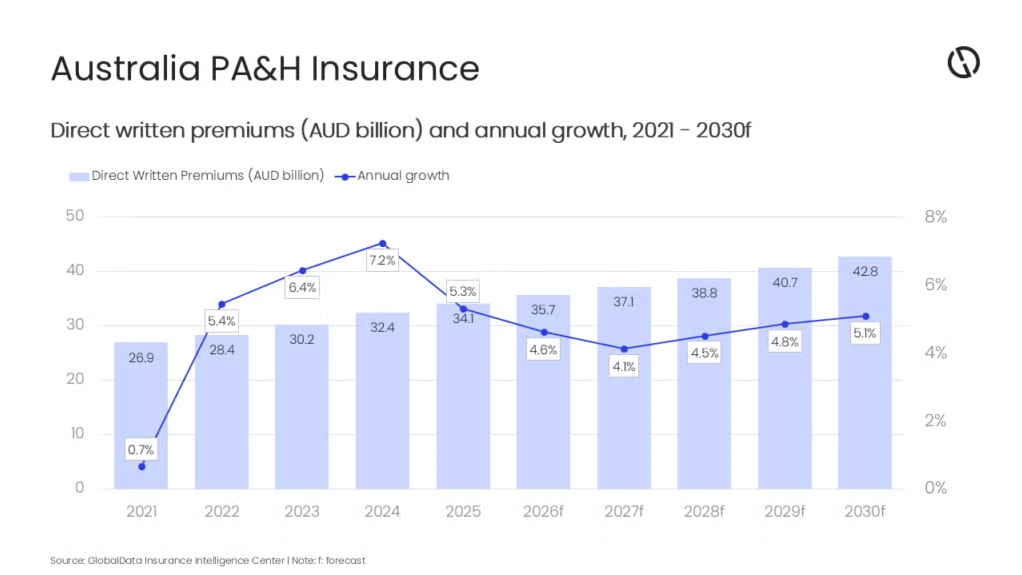
Australia’s personal accident and health (PA&H) insurance market is forecasted to register a compound annual growth rate (CAGR) of 4.6% from $23.5b in 2026 to $27.7b by 2030, in terms of direct written premium (DWP), according to GlobalData.
“The expansion of PA&H by 5.3% in 2025 reflects stable demand and pricing resilience, whilst 2026 growth aligns with moderating yet steady premium uplift, alongside continued consumer focus on health, wellness, and income protection benefits as insurers refine product design and service models,” Swarup Kumar Sahoo, Senior Insurance Analyst at GlobalData, said in a report.
The market was also estimated to have pencilled an annual growth of above 5% from 2022 through 2025, and will likely record a growth above 4% until 2030, the GlobalData report said.
Demand is supported by higher awareness of health and climate-related risks, wider use of digital and embedded distribution, and clearer regulation, even as competition remains intense and pricing conditions evolve.
Australians are increasingly turning to private health insurance to manage rising medical expenses and out-of-pocket costs.
Whilst parts of the wider insurance market are seeing a softer rate cycle, health insurance premiums have continued to rise, pointing to strong demand despite affordability pressures.
Figures from the Department of Health, Disability and Ageing show private health insurance premiums increased by an average of 3.73% in 2025.
An ageing population and a higher incidence of chronic conditions are expected to add further pressure on healthcare costs in 2026.
Based on rate increase requests submitted by insurers in November 2025, the department is consulting with the Australian Prudential Regulatory Authority and insurers, with initial estimates pointing to an average premium increase of around 4% in 2026.
Sahoo said climate risks, particularly heatwaves, are adding to mortality risks in urban areas and driving higher health expenditure and claims, increasing the need for more resilient coverage, especially for vulnerable groups.
Digital distribution and embedded insurance are also expanding access to PA&H products, whilst investment in insurtech and artificial intelligence is improving policy administration and claims handling.
These technologies are expected to play a larger role through 2030 as insurers expand telehealth and mental health offerings and refine risk analytics.
GlobalData said insurers will need to use digital tools to tailor benefits and manage risk more closely to control loss ratios, whilst keeping cover affordable for price-sensitive customers, as competition in the PA&H market continues to intensify.
“With sharpening competition, elevated claims in select health verticals, and accelerating digital/embedded distribution models, insurers that balance affordability, coverage innovation, and customer-centric service will be best positioned to capture growth and strengthen resilience in the coming years,” Sahoo added.

















 Read Here
 Advertise
 Sign Up