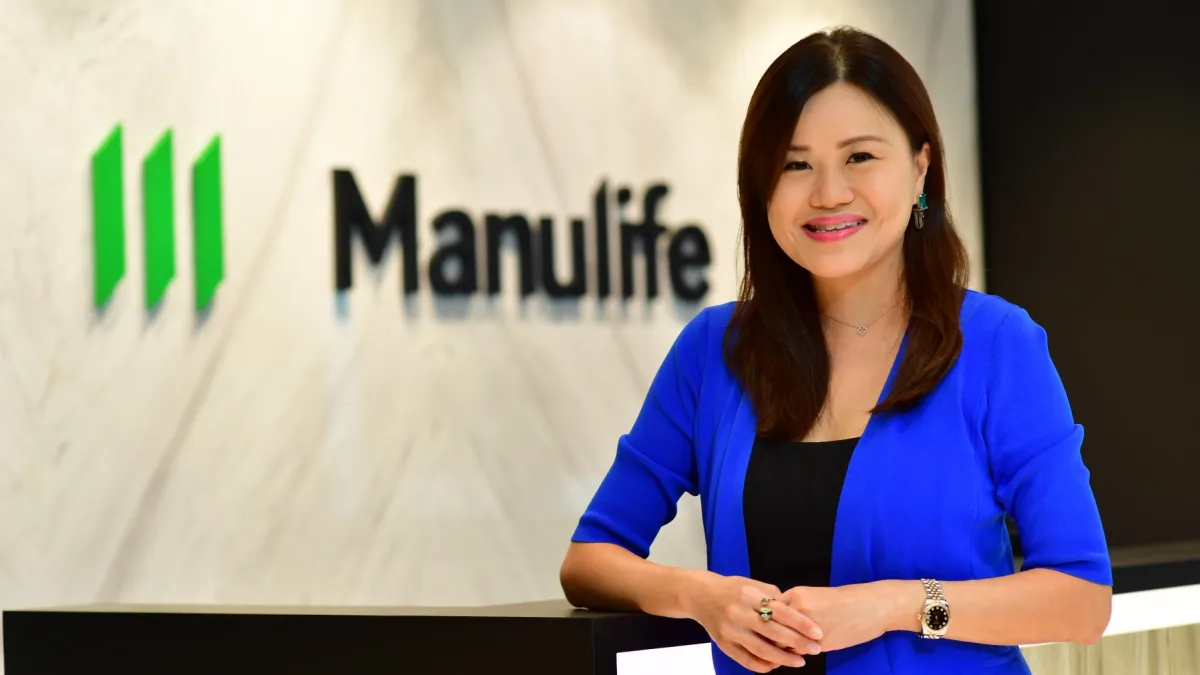
Manulife’s Leah Ng says better governance boosts women’s leadership
Equity cannot rely only on good intentions; it must be built into systems.
A senior executive at Manulife (Singapore) Pte. Ltd. said that insurers should formalise promotion systems as women continue to face structural barriers to reaching leadership roles.
Leah Ng, chief bancassurance officer at Manulife Singapore, said organisations often rely on good intentions and informal mentorship instead of measurable governance when it comes to advancing women into senior positions.
“Equity cannot solely rely on good intentions; it must be built into governance,” she told Insurance Asia in an emailed reply to questions.
She added that the challenge is not a lack of commitment but the absence of systems that make fairness in promotions transparent and measurable.
With more than two decades of experience in the life insurance and financial service sector, Ng said leadership diversity could strengthen company performance when it is embedded into how organisations operate.
The rest of the interview follows.
Looking back at your career, what was a difficult decision that helped your growth?
"I have experienced several defining moments throughout my career, shaped by opportunities I embraced and those I intentionally declined.
Two of such key moments happened [in my early] 20s. I was eager to contribute but often hesitated to speak up. A female manager noticed and encouraged me to make my voice heard at the table. That advice reshaped how I showed up as a contributor and my leadership style in later years by advocating for perspectives that matter.
During the later part of my career, I also found myself at a crossroads a few times where I was presented with roles that offered bigger titles and remuneration.
While enticing in the short term, they did not align with the long‑term path I had set for myself and my family's priorities. Choosing to walk away was difficult. As women, we often second‑guess our decisions more than we acknowledge.
However, looking back, these “strategic no’s” were critical for me as they helped me stay focused on a career built with intention rather than speed."
How does leadership diversity affect company performance?
"Diverse C‑suite teams influence not only the decisions we make, but the standards we set for performance. One critical operational habit that is a sign of leadership maturity is measuring contribution by outcomes rather than visibility.
When organisations focus on results and potential instead of assumptions, they unlock a wider talent pool and strengthen merit‑based advancement.
Another habit is the institutionalisation of structured sponsorship. High‑potential talent is identified early and offered stretch opportunities through deliberate governance.
This deepens succession pipelines, reduces attrition, and builds a more resilient organisation—strengthening both performance and continuity. When diversity becomes part of the operating model, it becomes an economic advantage."
What steps has Manulife taken to ensure fair promotions into leadership roles?
"At Manulife, we treat equitable progression as a structural discipline. Inclusion objectives are embedded into performance goals.
Leaders are evaluated not only on what they deliver, but on how they build inclusive, high-performing teams. This creates accountability in succession planning and talent decisions.
We also review leader inclusion dashboards and executive leadership team scorecards quarterly, including promotion pipelines and representation metrics. That transparency ensures decisions are data-informed rather than anecdotal.
Beyond mentoring, we actively identify high-potential women for structured leadership development and stretch assignments.
Advancement is not left to informal networks. Instead, access to opportunities is deliberately engineered and supported by measurable governance.
Personally, I also maintain a strong emphasis on a meritocratic approach to ensure that people are evaluated on strengths and impact. I encourage my team to document their achievements rigorously so that performance and potential can be assessed fairly and transparently."
How does the company support flexible work arrangements, especially for senior women leaders?
"At Manulife, flexibility is structured, supported by clear expectations and leadership accountability. Through engagement surveys and pulse checks, we refine our hybrid model using a disciplined share–plan–act approach.
Our 2025 engagement score placed us in the top quartile of Gallup’s Finance and Insurance benchmark, demonstrating that employee experience and high performance can co-exist.
As society and gender roles evolve, I believe that both men and women appreciate the flexibility their employers can afford them.
In recent years, I personally supported a high‑performing team member who considered resigning to accompany his spouse on a one‑year assignment in France.
Recognising the importance of flexibility, I worked with human resources to extend his sabbatical beyond our usual policy. He remains a valuable contributor today. The same principle applies to many colleagues, be it women or men, with caregiving needs—flexibility enables them to thrive in their roles professionally and personally."
If you could change one thing in the industry to speed up gender equality, what would it be?
"I would standardise transparency in promotion and succession criteria across the industry. Ambiguity is where bias takes root.
Clear, explicit, and consistently applied leadership criteria reinforce merit, strengthen trust, and give high‑performing women the confidence to pursue long‑term career pathways. Transparency ensures that career progression is not influenced by perception but anchored in capability and readiness.
As women in the workforce, we have the power to shape our own journeys. Stay curious, build new skills, and step forward with confidence. Opportunity favours the prepared. When it arrives, be bold enough to say yes."














 Read Here
 Advertise
 Sign Up