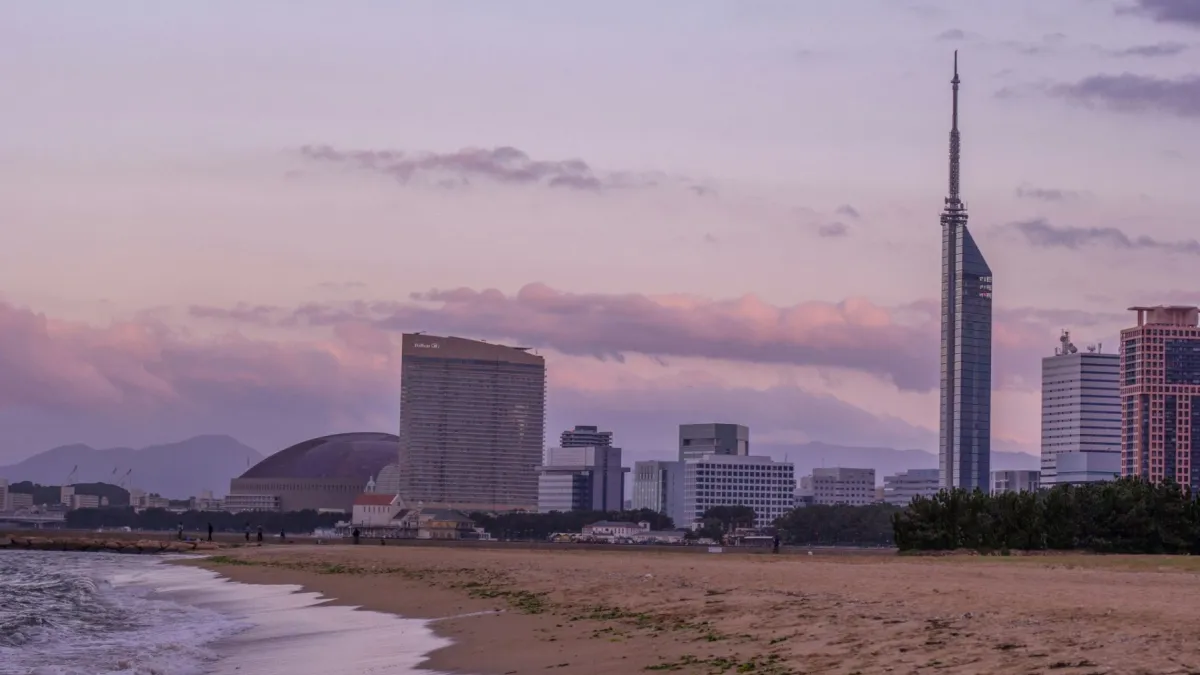
Fukuoka rises as key gateway to Japan for Hong Kong businesses
The city offers subsidies to R&D-heavy sectors like IT, medicine, and energy.
Hong Kong firms looking to expand into Japan should consider Fukuoka as an alternative to Tokyo given lower costs, fresh office supply and targeted state incentives.
Taishi Nakamura, Business Attraction Section director at the Fukuoka City Government, said Tokyo’s scale could be difficult for first-time entrants.
“If you go to Tokyo, you’re one of many, and it’s hard to know whom to talk to,” he told a news briefing for the Tenjin Redevelopment project in Japanese in November. “Fukuoka is a very compact city, and we actively support connections.”
Fukuoka has rolled out subsidies for foreign and foreign-affiliated firms, particularly in research and development-heavy sectors such as information technology (IT), digital content, medicine, and energy.
Eligible companies can receive rent subsidies covering a quarter of annual rent, capped at $764,000 (¥15m) for standard offices and $5.1m (¥100m) for large-scale offices. Employment subsidies are also available per hire, with total caps reaching $5.0m (¥100m).
For Hong Kong companies balancing cost, talent access and risk diversification, officials say Tenjin—Fukuoka’s central business district—offers a practical base.
Tenjin is undergoing a major redevelopment known as “Tenjin Big Bang,” replacing ageing buildings and upgrading infrastructure.
Ryoji Inoue, City Centre Revitalisation Section director at the Fukuoka City government, said many buildings in Tenjin and Hakata were more than 50 years old and built under outdated earthquake standards. Height limits linked to the nearby airport had also constrained development.
Those restrictions were eased in 2014 after Fukuoka was designated a national strategic special zone, allowing negotiations for taller buildings and higher floor-area ratios.
Since redevelopment began in 2015, about 90 buildings are expected to be completed by end-2026 within the 500-metre Tenjin core.
Office availability also differs from Tokyo. Whilst vacancy near Hakata Station is about 2%, Tenjin’s rate is about 9%, making entry easier for new tenants, Nakamura said.
Cost pressures in Hong Kong are another factor. In the city’s Central district, housing allowances can significantly raise total employment costs, with prime residential rents ranging from $15,000 to more than $20,000 a month, according to a 2026 salary guide by 9cv9 Pte. Ltd.
Meanwhile, wage growth in parts of the Greater Bay Area is narrowing regional pay gaps, increasing competition for technical talent.
Trade tensions have also weighed on confidence. A survey by CPA Australia Ltd. found 51% of Hong Kong companies reported negative effects on 2025 performance, with 24% relocating or restructuring operations.
Foreign firms have begun establishing a presence in Tenjin. NUNAI Ltd., an artificial intelligence-driven immersive experience studio founded by British entrepreneurs Julian Munro and Carl de Beer, chose Fukuoka as its Japan base.
“We feel that there is a lot of investment and growth in Fukuoka City itself, and being in a place like CIC gives us many opportunities to network,” Munro told the same briefing, adding that support from the city government reinforced the decision.
Fukuoka’s economy is about 90% service-based, according to Nakamura. The city prioritises IT, digital content, and knowledge industries, and has introduced a fast-track “Engineer Visa” for foreign specialists, later expanded to include semiconductor professionals.
Since launching its Engineer Café in 2019, the city has recorded more than 100,000 users. Over the past decade, related businesses have more than doubled and employment has tripled, Nakamura said. Fukuoka produces roughly 7,000 science and engineering graduates each year.
For Hong Kong firms facing regional competition for engineers, Tenjin offers a smaller but less saturated talent market.
Daisuke Tsutsumi, head of Fukuoka Office, Money Forward, Inc. said that amongst its engineers in Fukuoka, there are hires recruited directly from overseas rather than through internal transfers, reflecting the city’s growing international pull.
Financial firms are also expanding in Tenjin. Nakamura said 35 finance-related companies, including fintech players, have set up there over the past five years, including E.SUN Commercial Bank Ltd.
Energy costs may provide another advantage. Electricity prices in Kyushu are 10% to 20% lower than in eastern Japan, supported by renewable and nuclear generation, according to Tensor Energy, Inc.
“If a company wants to establish a base in Japan, Fukuoka is a good option because it can be used for test marketing and provides a base from which to later expand towards Tokyo,” Nakamura said.
($1.00 = ¥19.86)

















 Read Here
 Advertise
 Sign Up